

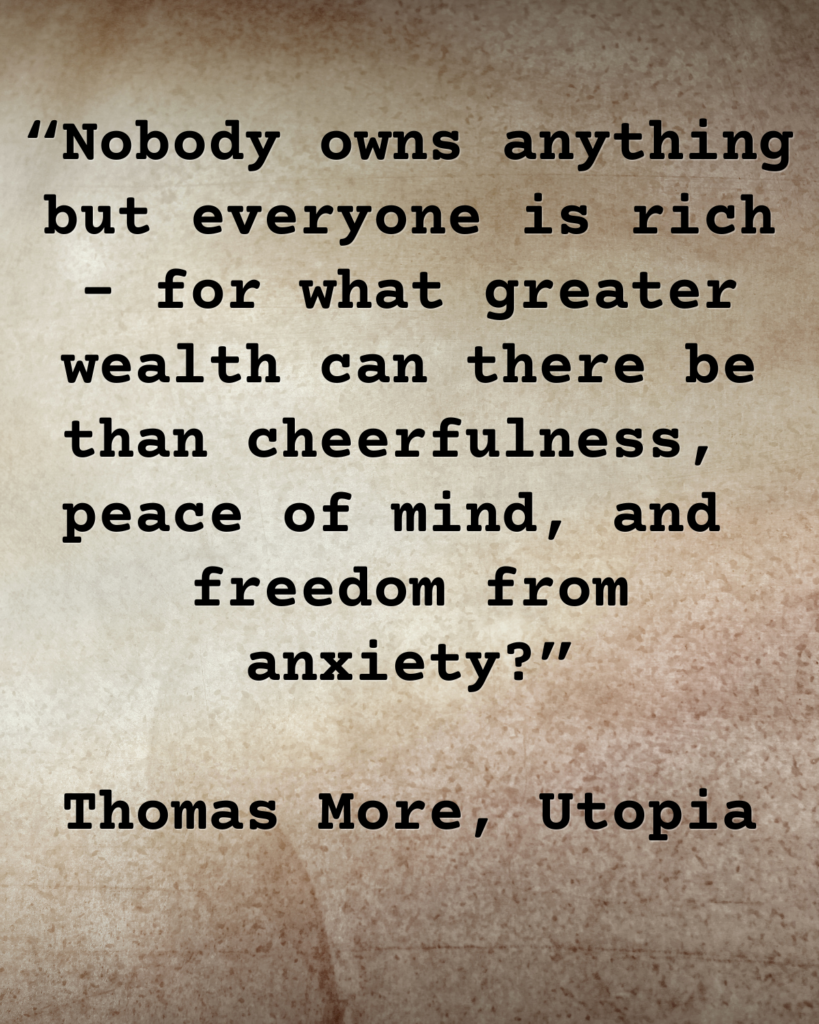
Sir Thomas More’s Utopia, especially in the introduction by John Anthony Scott (Washington Press), invites readers into a thought experiment that still feels uncomfortably relevant in 21st century America. When I first studied the Reformation during my undergraduate years—particularly the Renaissance period—I remember being struck by how deeply thinkers like More were wrestling with questions we still ask today: What does a good society look like? And why does the “perfect” world always seem just out of reach?
More’s imagined island of Utopia is orderly, rational, and structured around shared resources and communal living. On the surface, it appears ideal. But beneath it lies a quiet tension: the cost of perfection is often the loss of individuality, desire, and even spiritual freedom. That tension is where this centuries-old text speaks directly into our modern lives.


In many ways, contemporary American culture mirrors the same restless pursuit of “utopia”—just expressed differently. We chase success, productivity, curated lifestyles, financial security, and personal reinvention. Yet even with unprecedented access to comfort and convenience, many still feel spiritually depleted. More’s work subtly asks whether external perfection can ever satisfy internal longing.

This is where Scripture offers grounding wisdom. Jesus reminds us in John 18:36, “My kingdom is not of this world.” Paul echoes this in Romans 12:2, urging believers, “Do not conform to the pattern of this world, but be transformed by the renewing of your mind.” These verses stand in contrast to both More’s fictional society and our real-world systems that promise fulfillment through structure, achievement, or social design.
From a faith perspective, Utopia becomes less about building the perfect society and more about recognizing the limits of human systems altogether. The Reformation thinkers I studied wrestled with this same truth: human institutions, no matter how well-intentioned, cannot replace the transforming work of God in the heart.

At Chicks on the Road Publishing, this reflection connects deeply with the philosophy of hygge, lagom, lykke, and jeong. These cultural concepts remind us that meaning is often found not in perfection, but in presence. Hygge invites warmth and simplicity. Lagom calls us to “just enough.” Lykke points toward joy found in ordinary life. Jeong speaks to deep relational connection and shared humanity.
Seen through this lens, More’s Utopia becomes a cautionary mirror. It challenges us to ask whether our pursuit of “ideal living” has pulled us away from what is already good, sacred, and real in front of us. Perhaps the truest “utopia” is not a place we design, but a way of living rooted in faith, gratitude, and community.

In a culture constantly striving for more, Utopia quietly whispers a countercultural truth: perfection is not the destination—presence is.